Evidence Workbench
COMPUTATIONAL RESEARCH PORTFOLIO · CHEMBL243
HIV-1 protease modeling,
with the uncertainty left in.
A transparent ChEMBL workflow for scaffold-aware potency modeling, applicability checks, and retrospective compound prioritization.
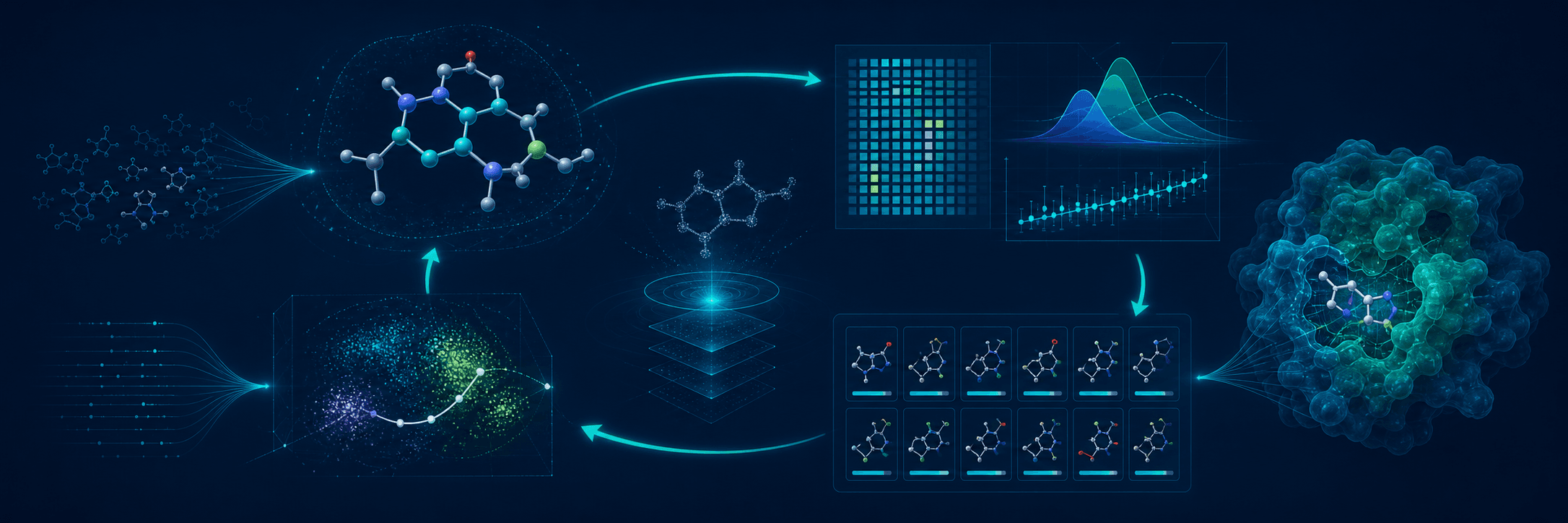
Which unseen-scaffold compounds deserve review—and where should the model be distrusted?
HOLDOUT PERFORMANCE
RMSE −29.3%Model evidence, not a victory lap
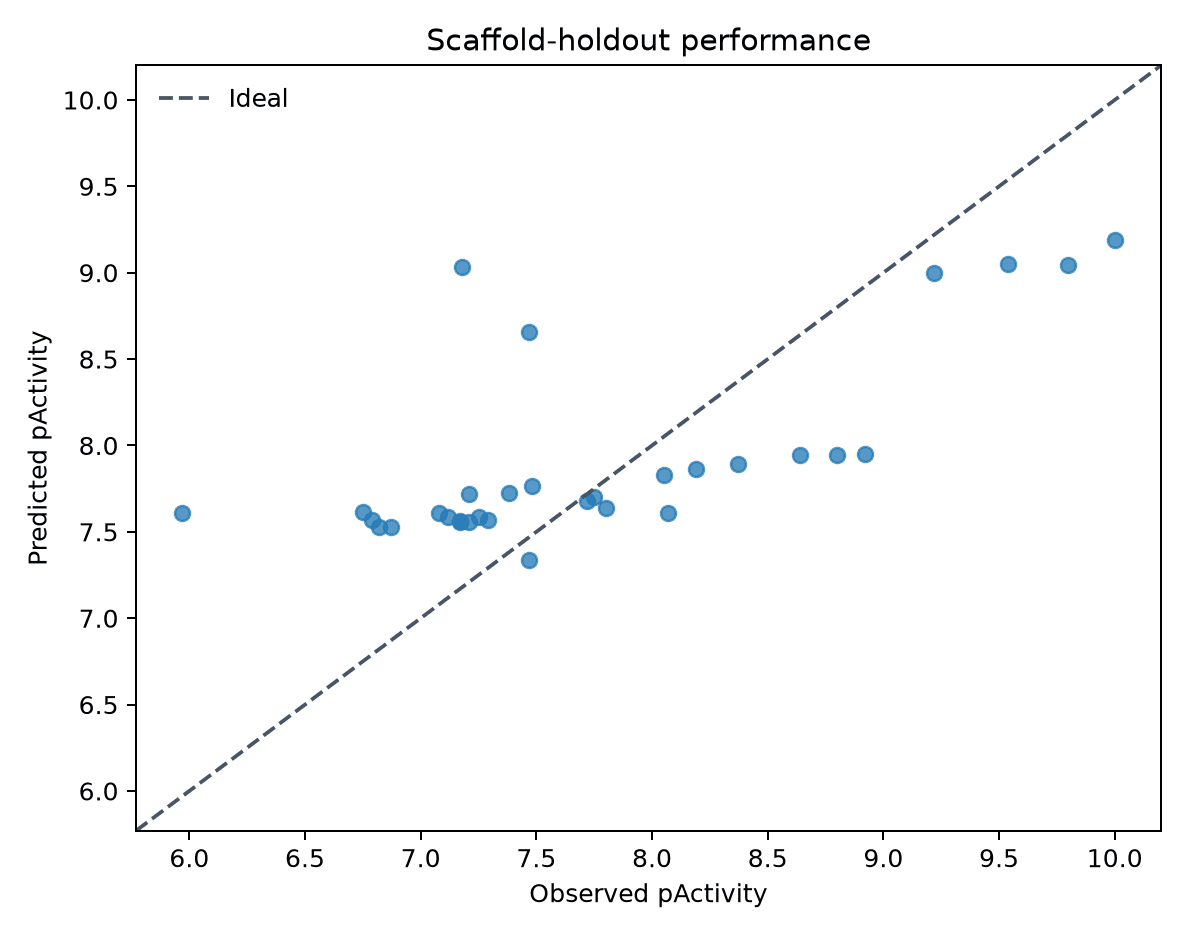
The model improves on the identical mean baseline, while the scatter makes regression-to-the-mean and high-activity underprediction visible.
- Scaffold separation
Tests transfer to structurally distinct chemistry instead of memorizing close analogues.
- Uncertainty retained
Tree dispersion travels with every candidate rather than disappearing behind a point estimate.
- Domain context
Nearest-training similarity makes chemical extrapolation visible and actionable.
02 / COMPOUND REVIEW
A decision table connected to the evidence behind each rank.
These are measured ChEMBL compounds held out by scaffold. The interface does not present generated ligands or docking scores because this repository did not produce them.
RETROSPECTIVE REVIEW QUEUE
Held-out compound evidence
| Rank | Compound | Pred. pActivity | Uncertainty | Train similarity | MW | cLogP | Priority |
|---|---|---|---|---|---|---|---|
| 01 | CHEMBL138828 ↗ | 9.190 | 0.650 | 0.852 | 560.7 | 4.00 | 0.911 |
| 02 | CHEMBL139804 ↗ | 9.048 | 0.717 | 0.768 | 558.7 | 4.82 | 0.800 |
| 03 | CHEMBL138300 ↗ | 9.043 | 0.717 | 0.768 | 560.7 | 4.21 | 0.798 |
| 04 | CHEMBL342365 ↗ | 8.996 | 0.798 | 0.746 | 634.6 | 5.20 | 0.752 |
| 05 | CHEMBL139756 ↗ | 9.034 | 0.764 | 0.704 | 586.7 | 4.94 | 0.744 |
| 06 | CHEMBL71472 ↗ | 7.946 | 0.284 | 0.789 | 549.7 | 5.43 | 0.584 |
| 07 | CHEMBL71153 ↗ | 7.950 | 0.347 | 0.769 | 563.7 | 5.68 | 0.558 |
| 08 | CHEMBL70386 ↗ | 7.946 | 0.358 | 0.763 | 549.7 | 5.38 | 0.550 |
| 09 | CHEMBL324657 ↗ | 7.700 | 0.252 | 0.789 | 615.7 | 2.07 | 0.518 |
| 10 | CHEMBL21166 ↗ | 8.654 | 1.145 | 0.657 | 528.7 | 5.54 | 0.516 |
| 11 | CHEMBL324377 ↗ | 7.680 | 0.282 | 0.789 | 613.8 | 2.68 | 0.505 |
| 12 | CHEMBL108102 ↗ | 7.722 | 0.302 | 0.776 | 617.7 | 2.51 | 0.505 |
Ranks are generated without exposing held-out activity labels. They are retrospective review aids, not candidate nominations.
RETROSPECTIVE LEARNING LOOP
Selection quality is tested across label-reveal rounds.
External-scaffold RMSE moved from 0.873 to 0.736 across three simulated rounds. The labels already existed; this is workflow evidence, not a laboratory result.
Inspect generated table ↗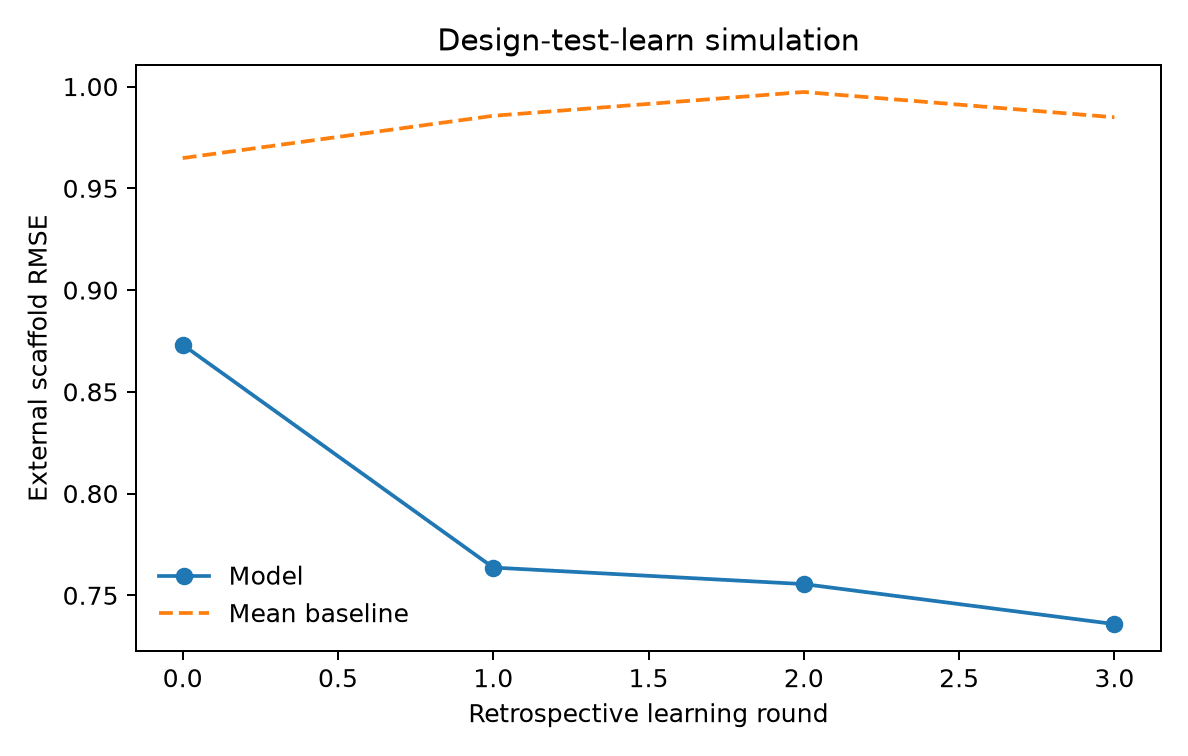
03 / REPRODUCIBLE METHOD
Six stages. One visible chain of evidence.
Exact ChEMBL IC50 values in nM; canonical structures aggregated by median pActivity.
Bemis–Murcko scaffolds are kept entirely in train or holdout data to limit analogue leakage.
Morgan fingerprints and Extra Trees are compared with a mean-prediction baseline.
Tree dispersion and nearest-train Tanimoto similarity expose uncertainty and domain risk.
A documented score combines prediction, uncertainty, similarity, and a broad MW screen.
Held-out labels are revealed only in a retrospective design–test–learn simulation.
Useful for prioritization.
Insufficient for a drug claim.
Included
Public-data curation, molecular standardization, scaffold validation, baseline comparison, uncertainty, applicability checks, and retrospective ranking.
Not included
Docking, generated molecules, ADMET validation, calibrated uncertainty, wet-lab assays, binding confirmation, safety, efficacy, or clinical conclusions.